Listening to Learn is an exciting new K–5 digital interview tool by highly respected educators Marilyn Burns and Lynne Zolli. Just released from Heinemann this April, Listening to Learn math interviews are one-one-one assessments that help teachers learn how their students reason numerically — the essential information they need to plan instruction.
In this blog, we’re going to keep up with Marilyn’s Listening to Learn Twitter chat, so you can learn more about math interviews and share what you learn with your friends and colleagues.
Whether you've been following along with the Twitter chat from the beginning or are just seeing these video clips for the first time, we invite you to watch the clips below and share your thinking either in the blog comments or on Twitter using #ListeningToLearn. Be sure to follow @mburnsmath to see the new video every Wednesday evening.
We suggest you start with this brief overview video to get an initial sense of the importance and usefulness of Listening to Learn.
The first video clip Marilyn shared was an interview conducted by coauthor Lynne Zolli. This is Listening to Learn: Interview 2, Addition and Subtraction within 10.
Reasoning always before memorizing! She didn't know the answer from memory, but relied on a fact she knew. And she applied the inverse relationship between addition & subtraction. Makes my heart sing. https://t.co/zbl4eRIwET #MTBoS pic.twitter.com/AlurJbIjlO
— Marilyn Burns (@mburnsmath) March 31, 2021
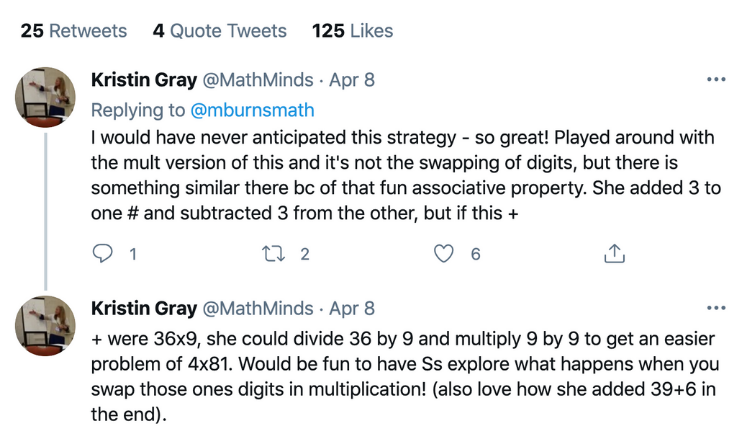
Interviews often surprise me. First she gives a wrong answer, then rethinks & changes 36 + 9 to 39 + 6 to get the right answer. Is the switcharoo OK? Would it work for subtraction? Multiplication? https://t.co/zbl4eRIwET pic.twitter.com/HpCmnB3JgE
— Marilyn Burns (@mburnsmath) April 7, 2021
The following week Marilyn shared this video, where she interviews a student using Listening to Learn: Interview 4, Addition and Subtraction Within 100
In this clip, we get a sense of Listening to Learn: Interview 1, Foundations of Numerical Reasoning from watching @amycmayfield present a problem to a Kindergarten student.
Word problems are so important. Start them young, start them right. I love how he used a context from his world to help explain. https://t.co/zbl4eRIwET pic.twitter.com/sHcTTpC9rl
— Marilyn Burns (@mburnsmath) April 14, 2021
Marilyn then posted a video of Rusty Bresser presenting a student with the first question from Listening to Learn: Interview 6, Foundations of Multiplication.
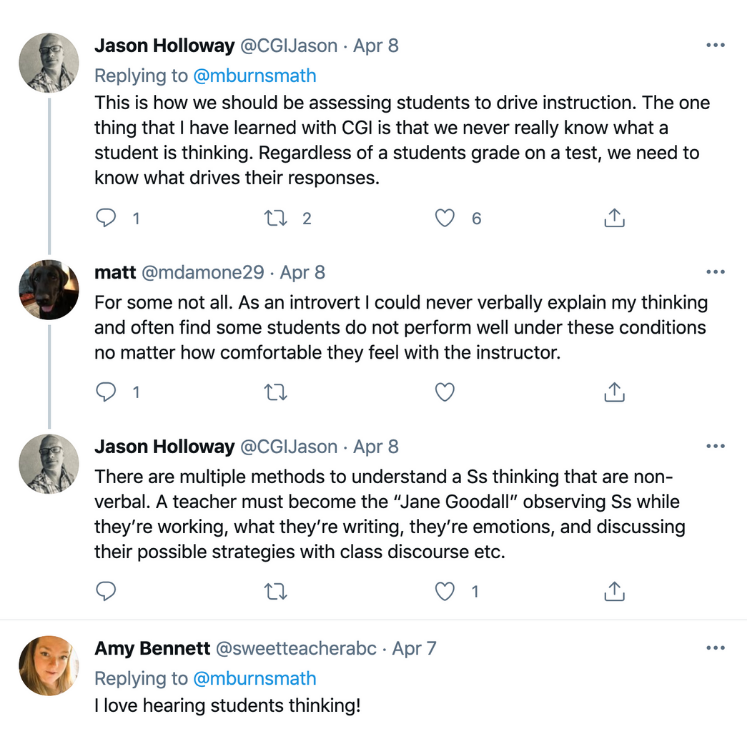
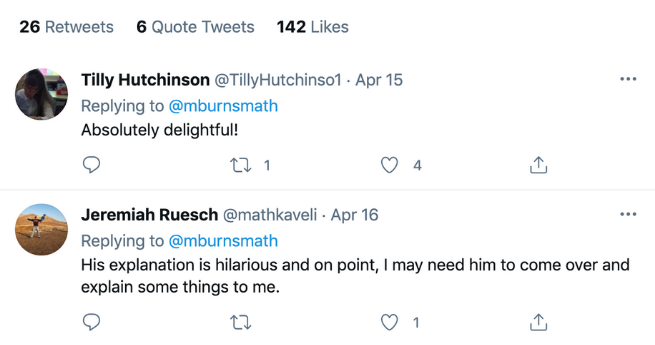
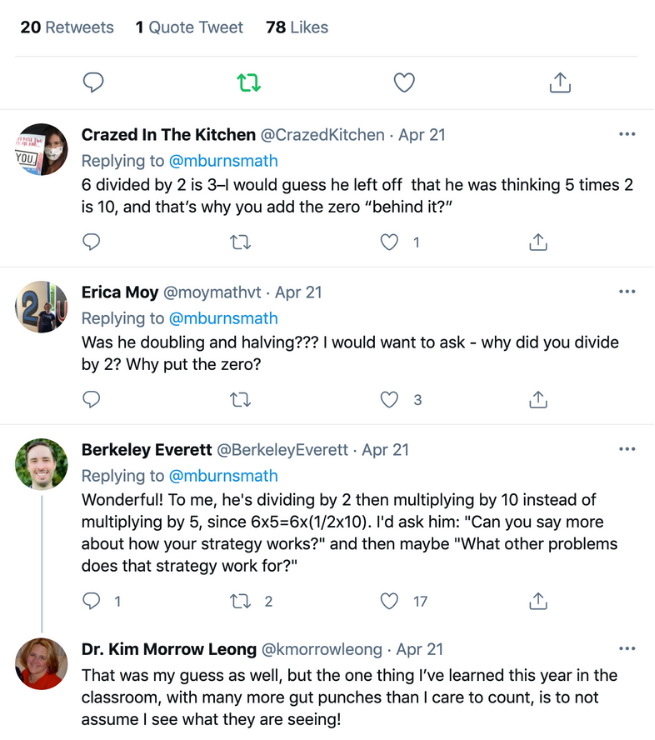
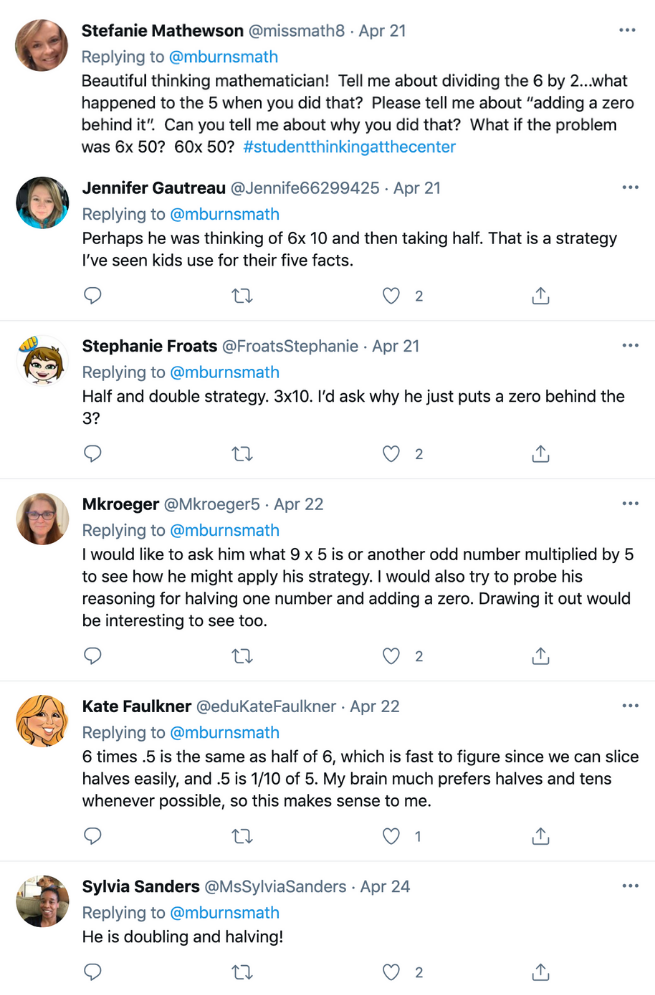
Another LTL interview clip. What is 6 x 5? He knew the answer without figuring and explained with confidence. But what was he thinking??? I'm still wondering. Can you explain the math behind what he said? What would you like to ask him? https://t.co/sUINcY8Krc pic.twitter.com/xuIwS22ONT
— Marilyn Burns (@mburnsmath) April 22, 2021
Next, Marilyn shared a video featuring a word problem from Listening to Learn: Interview 10, Fractions & Decimals.
I love this problem, for students & adults: Notebooks cost $1.39. How many can you buy for $5? No paper or pencil. Listen to how she used $4.20 to help her decide. Interviews provide an extraordinary opportunity to learn how students reason. https://t.co/zbl4eS083t pic.twitter.com/YDgH0Il2TX
— Marilyn Burns (@mburnsmath) April 29, 2021

This time, Marilyn shared a pair of videos showing two students, one interviewed by Marilyn and the other by Lynne, answer the same question from Listening to Learn: Interview 8, Extending Multiplication & Division.
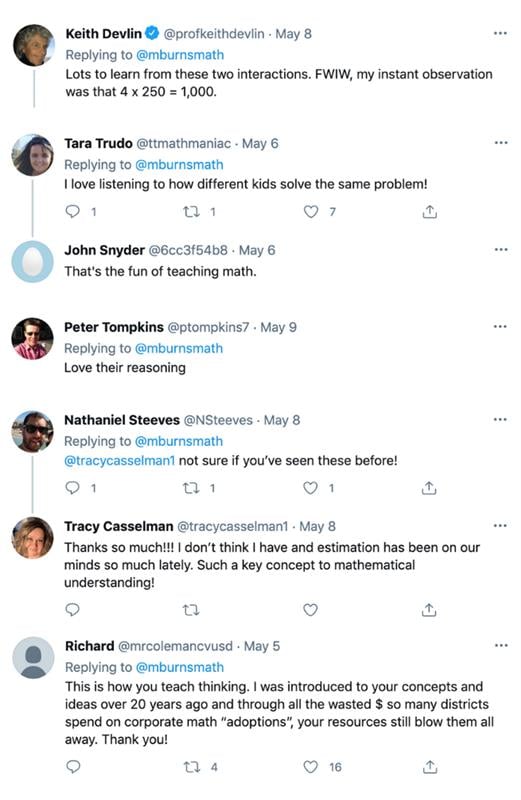
An estimation problem: Is 187 x 4 greater or less than 1000? No paper or pencil. How would you decide? Listen to two students, two different explanations. #MTBoS https://t.co/zbl4eRIwET pic.twitter.com/b40X9CXWN4
— Marilyn Burns (@mburnsmath) May 5, 2021
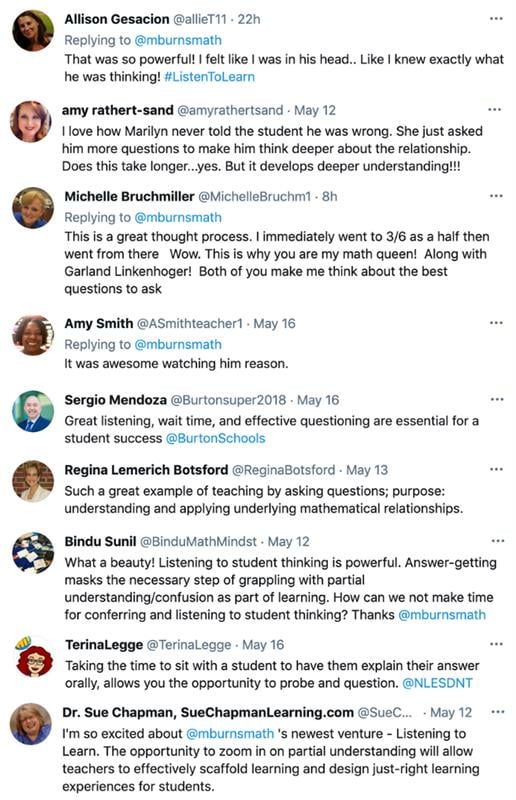
The next video highlights that partial understanding and confusion are part of learning in Listening to Learn; Interview 9, Foundations of Fractions.
Where does 3/5 go on a number line? The odd denominator made for a challenge! This exchange reminded me that partial understanding & confusion are part of learning. https://t.co/zbl4eRIwET #MTBoS pic.twitter.com/9qUVyYZFjh
— Marilyn Burns (@mburnsmath) May 12, 2021
As is evident in this video, memorization is not enough alone. As you can see, her first instinct is to lean on what she's memorized, but when she comes up short, it's her ability to reason that gets her over the finish line.
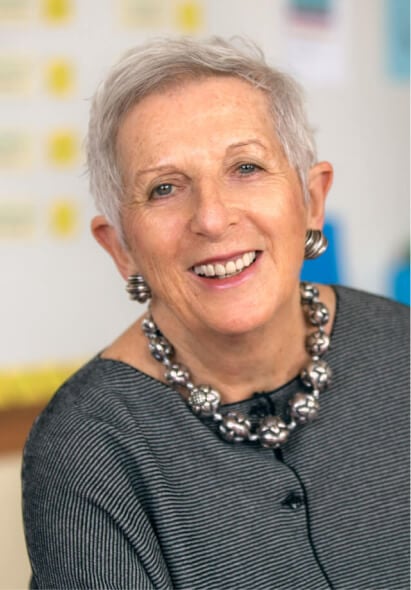
Marilyn Burns is one of today’s most highly respected mathematics educators. Over the course of more than fifty-five years, Marilyn has taught children, led in-service sessions, spoken at conferences, contributed to professional journals, and written more than thirty books and resources for children and educators.
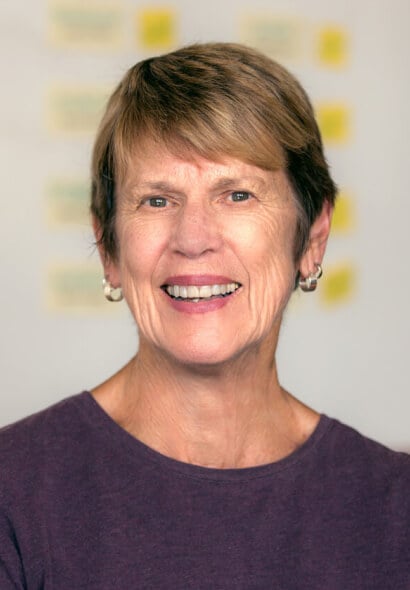
Lynne Zolli was a classroom teacher in the San Francisco Unified School District for over forty years and taught grades 1 through 6. She also was a mentor teacher, professional development leader, Math Solutions instructor, and conference speaker. Lynne is a grant writer, an author of Math Solutions professional books, and a co-author of Do the Math.