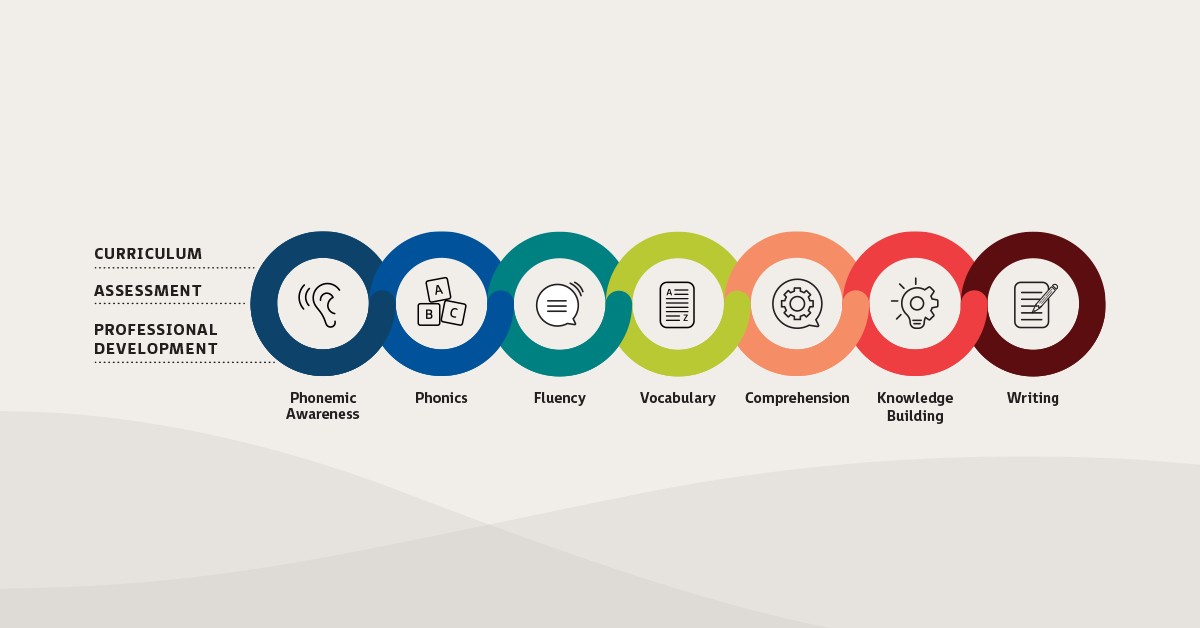
Educators everywhere share a common goal: helping every student become a confident, capable reader and writer. Achieving this requires more than isolated strategies—it calls for a comprehensive approach to literacy instruction, one that integrates foundational skills, knowledge-building, writing, assessment, and professional learning into a cohesive system.
This blog will explore teaching phonics within a comprehensive approach to literacy instruction and is the second post in a series exploring each essential component.
Phonics is most powerful when instruction is systematic, explicit, and practiced in connected text.
What is Phonics?
Phonics is the teaching of relationships between sounds and the letters or letter patterns that represent them. Students learn to connect phonemes to graphemes and then apply those correspondences to read and spell words. While phonics differs from phonemic awareness, which is purely auditory, the two work together. When students can hear, blend, and segment sounds, phonics provides the print mapping that turns those sounds into words (Dehaene, 2009; NICHD, 2000).
Why Phonics Matters
A comprehensive approach to literacy includes the five pillars of reading along with knowledge building, writing, assessment, and professional learning, with phonics connecting directly to each of these components. Strong decoding reduces cognitive load, which frees attention for meaning and supports fluency and comprehension (Pikulski & Chard, 2005; Willingham, 2017). As students internalize letter sound correspondences and patterns, they store words for instant recognition through orthographic mapping, a process central to both reading and spelling development (Castles, Rastle, & Nation, 2018; Ehri, 2014).
Understanding the Research on Phonics
Decades of research point to consistent findings:
- Systematic phonics instruction improves word reading and prepares students for more advanced literacy tasks (Castles, Rastle, & Nation, 2018).
- Orthographic mapping explains the process by which readers form permanent links between a word’s sounds, spelling, and meaning, allowing them to recognize the word instantly (Ehri, 2014).
- Foundational oral language skills activate neural pathways that link speech sounds to print, making phonics instruction more efficient (Dehaene, 2009; NICHD, 2000).
Principles for Effective Phonics Instruction
Effective phonics instruction is clear, cumulative, and connected. The following principles can help teachers design daily lessons that build durable skills:
- Follow a systematic, sequential scope and sequence that introduces correspondences and patterns in a logical progression with cumulative review.
- Teach explicitly with modeling, guided practice, and independent practice supported by timely feedback (Fisher, Frey, & Hattie, 2016).
- Provide opportunities for students to read connected text through decodable materials aligned to what they have been taught so transfer is immediate and meaningful (Pikulski & Chard, 2005; Willingham, 2017).
- Expand morphology instruction in upper elementary grades to support vocabulary and meaning making (Beck, McKeown, & Kucan, 2013).
Scope and Sequence Across Grades
Phonics instruction progresses along a predictable continuum from simple letter-sound correspondences to complex patterns and multisyllabic decoding. A grade band view can help teachers plan intentional instruction.
Phonics in Kindergarten to 1st Grade
Focus on letter-sound correspondences, short vowels, common consonants, VC and CVC words, and high-frequency words. Daily blending and segmenting bridge speech and print and prepare students for decodable text practice aligned to taught patterns (Ehri, 2014; NICHD, 2000).
Phonics in 2nd to 3rd Grades
Extend instruction to long vowels, digraphs and blends, r-controlled vowels, vowel teams, syllable types, and foundational morphology. Cumulative review and controlled text support accuracy, fluency, and comprehension (Pikulski & Chard, 2005; Willingham, 2017).
Phonics in 4th to 5th Grades
Apply advanced multisyllabic decoding strategies and deepen knowledge of morphology. Work with prefixes, roots, and suffixes connects decoding to vocabulary and supports comprehension in increasingly complex texts (Beck, McKeown, & Kucan, 2013; Duke & Cartwright, 2021).
Classroom Routines for Teaching Phonics
Predictable routines can help students practice efficiently and apply skills during reading and writing.
Explicit minilesson: Model the target pattern using clear examples and brief checks for understanding so students know what they are learning and why it matters (Fisher, Frey, & Hattie, 2016).
Blending and segmenting practice: Move from oral to print with word building, dictation, and pattern sorts. These routines reinforce decoding and encoding (Ehri, 2014; NICHD, 2000).
Decodable text application: Provide connected text aligned to the sequence. Listen in, prompt efficient strategies, and use observations to inform the next lesson. Decodable practice supports smooth transfer to authentic reading (Pikulski & Chard, 2005).
Word study and pattern work: Engage students in word families, spelling patterns, and syllable types. In upper grades, integrate morphology work to support vocabulary growth.
Practical Tips for Teaching Phonics
A few intentional moves can help phonics instruction feel clear, consistent, and immediately useful to students.
- Keep routines predictable so students can focus on the new pattern rather than the structure of the lesson.
- Use clear, concise language when modeling sounds and letter formations to strengthen sound–symbol connections.
- Revisit new correspondences throughout the day in brief, natural moments to support transfer.
- Give immediate, specific feedback that guides students toward self-correction and reinforces strategic thinking.
- Celebrate small milestones to build confidence and help students see their growing independence as readers and writers.
Integrating Phonics with Literacy Instruction
Phonics instruction strengthens when it is woven throughout the literacy block and supported by complementary practices. Short oral warmups reinforce phonemic awareness and prepare students to connect sounds to print, making the shift into decoding more automatic. During reading time, guided and repeated reading provide structured opportunities to apply newly learned correspondences in connected text. This practice improves accuracy and expression while building the fluency students need to focus on meaning.
As students encounter increasingly complex words, brief morphology work helps them understand how word parts contribute to meaning. These insights support vocabulary development and make decoding more efficient. Throughout the day, text-based discussions and teacher think-alouds show how decoding and comprehension operate together within conceptually coherent texts. Writing in response to reading, including dictation and short written summaries, reinforces phonics patterns by prompting students to encode words deliberately. When these routines are integrated consistently, students learn to use phonics flexibly across reading and writing tasks, which strengthens both understanding and independence (Cervetti, Wright, & Hwang, 2016; Graham & Hebert, 2010).
Recommended Resources for Phonics Instruction
The following Heinemann resources align with core instruction and offer a range of supports for phonics learning across Grades K–5.
Jump Rope Readers
A decodable series designed for early readers. Fiction and nonfiction texts align to phonics patterns so students can apply newly taught skills in connected reading.
Moonlit Mountain Readers
Engaging decodable texts across genres that reinforce sound letter relationships and maintain momentum during practice.
Saxon Reading Foundations
A structured foundational skills program aligned to the Science of Reading. Lessons support phonemic awareness and phonics for whole class and intervention settings.
The Reading Strategies Book 2.0
A practical resource for differentiation and foundational skills support. Teachers can select strategies that align to individual student goals.
Units of Study in Reading
An inquiry-based curriculum that connects phonics, decodable practice, fluency, and comprehension within workshop structures.
How Heinemann Supports a Comprehensive Approach to Literacy
For over 40 years, Heinemann has partnered with educators to deliver research-based literacy resources that reflect the realities of the classroom. Rather than offering one-size-fits-all programs, Heinemann provides inquiry-based, differentiated resources that align to specific goals.
By supporting every facet of literacy, and every educator delivering literacy instruction, we help schools move toward more intentional and effective literacy outcomes.
Editor’s note: For complete research citations for this blog post, please download the ebook, Establishing Effective Instruction through a Comprehensive Approach to Literacy.
***
Ready to strengthen your literacy instruction? Download our free ebook, Establishing Effective Instruction through a Comprehensive Approach to Literacy, and explore how you can build a more impactful, student-centered literacy program. Or watch the edLeader Panel with scholars Carol Jago, Lorna Simmons, and Dr. JT Torres for a conversation exploring how foundational literacy skills, strategic fluency development, and deep comprehension work in harmony to empower confident, lifelong readers.
Learn more about Heinemann's literacy resources.
Learn about establishing effective instruction with a comprehensive approach to literacy.