Dr. Karen Fuson has long believed that math is a language every child deserves to speak. Her research in classrooms that include multilingual learners has shaped a vision where academic language grows alongside mathematical thinking.
Multilingual learners often face the dual challenge of mastering mathematical concepts while learning the English language. Language proficiency is essential when learning math, but with the right supports and strategies, multilingual students’ confidence can flourish as they better understand mathematical language and concepts.
The Research Foundation
Fuson spearheaded the Children’s Math Worlds (CMW) Research Project, a 10-year study on how to effectively teach students math from an early age. This research found that Math Talk is a vital component of an effective mathematics classroom and was instrumental in the development of the Math Expressions curriculum, which emphasizes Math Talk.
Math Talk describes discourse, usually led by the teacher, that facilitates students expressing their mathematical thinking through four components: questioning, explaining mathematical thinking, sharing mathematical ideas, and taking responsibility for learning. These components work together to create a classroom environment where mathematical discourse becomes natural, building both linguistic confidence and mathematical fluency.
The CMW Research Project also revealed that multilingual learners improve when they have many opportunities to hear and speak through sense-making supports in the classroom. These supports connect informal foundational mathematics to formal school mathematics by using mathematical language and drawings that help students reflect, abstract, and generalize, which is something that Math Expressions is designed to support.
Math Talk in Action
One success story demonstrates the powerful impact of Math Expressions and its language development components on multilingual learners. In an elementary classroom where most students were multilingual learners and still developing their English, Fuson explains how they were using English while discussing mathematical processes.
“These kids do not know English words for face, hand, or body parts, but they are explaining. These are second graders explaining two-digit subtraction with ungrouping in English,” Fuson says, “It was a supportive classroom where kids were expected to learn to speak mathematically in English.”
Fuson’s approach doesn’t separate language from learning. It invites students to speak, reason, and lead. “They could go up to the board with a friend to explain. Everyone was expected to speak in English and explain their methods,” she explains.
Fuson recalls moments when students chose to stay inside during recess, not because of bad weather, but because they hadn’t resolved a problem. “They hadn’t yet convinced themselves why [a problem was] true . . . so it was more important to them to figure out the answer than to go out to recess,” she says.
In another example, a substitute teacher came into a classroom where there was a good, nurturing Math Talk community that also inspired students to take on leadership roles. The teacher was met with a student who stood up and explained how things worked when their regular teacher was there. According to Fuson, the student said, “Excuse me. In this class, students explain their thinking. We talk and explain. So, you should ask us questions and let us do the explaining.”
These moments reflect more than instructional success. They reveal a classroom culture where students discover what they’re capable of through language, connection, and confidence.
How Math Expressions Supports Math Talk
Math Expressions embeds language development into every part of the learning experience, providing various ways for students to engage in Math Talk, such as:
- Solve, Explain, Question, and Justify at the Board
- Step-by-Step at the Board
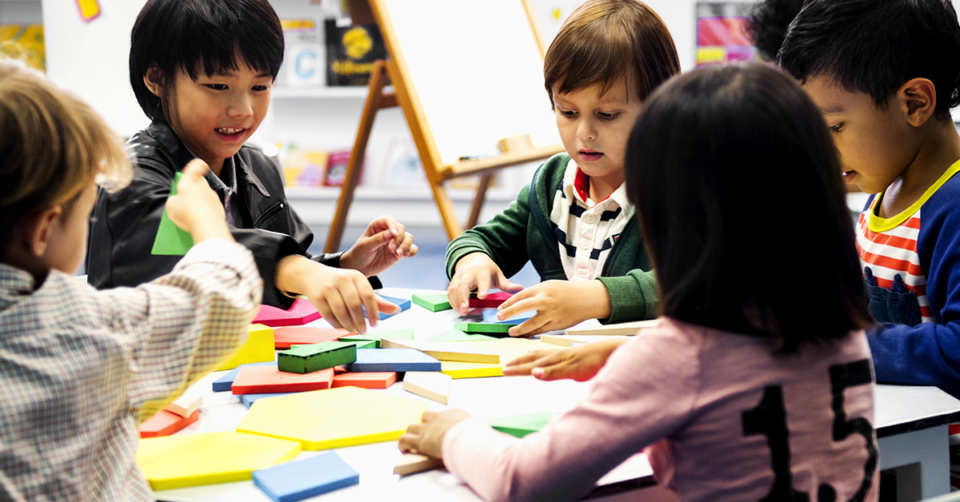
- Student Pairs
- Small Groups
- Whole-Class Practice with Student Leaders
In addition to Math Talk, students use modeling and peer support to express their ideas clearly and confidently and further deepen their mathematical understanding.
Modeling consists of peers who understand concepts demonstrating their knowledge to their classmates. Peer support involves students explaining their thinking to one another and collaborating to deepen understanding. Math Talk, modeling, and peer support work together to foster an encouraging classroom environment that builds language through meaningful mathematical discourse.
Teachers can further facilitate Math Talk by providing language scaffolds or asking open-ended questions that help students explain their reasoning. The blog post “How to Introduce Math Talk into Your Classroom” offers more strategies for teachers.
When provided with opportunities to practice, apply, and discuss mathematical concepts, students can develop deep conceptual understanding and grow into effective mathematical communicators in the math classroom and beyond. As Fuson’s research demonstrates, students can confidently explain complex mathematical ideas, even in a second language, when supported through Math Talk strategies, peer modeling, and a nurturing classroom community.
***
See how Fuson’s Math Expressions supports multilingual learners with embedded language scaffolds, peer modeling, and visual tools that build academic language through math. The overview brochure provides more on what’s included, empowering students to explain, reason, and lead.
Explore Math Expressions with instant access to the program overview.