Adapted from The Teaching Life by Kelly Gallagher
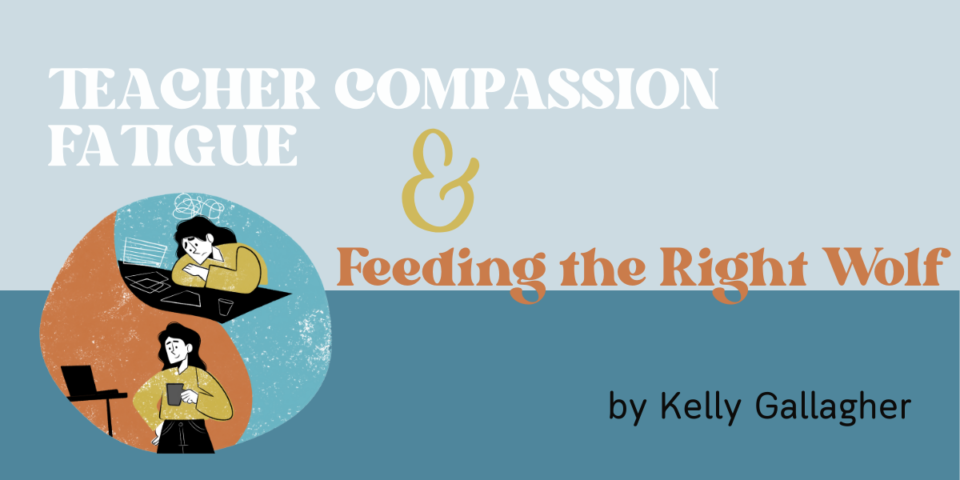
What We Mean When we Talk About Compassion Fatigue
The cost of caring for others can numb and desensitize you.
I once had a student privately confide in me that her parents were getting a divorce and that she was overwhelmed by this volcanic disruption in her life. I don’t remember what I said to her, but I do remember that at the end of the day it suddenly occurred to me that she had needed much more than I gave her in that moment.
Earlier, in that same week, I had called Child Protective Services after a student told me she had been raped, I had given money to a different student who confided he was homeless and hungry, and I had ushered yet another student into a counseling appointment after I discovered she was cutting herself. And that was only Wednesday. So when the student confided in me that she was devastated by her parents’ divorce, my first thoughts in that moment were, “It’s just a divorce. There are a lot of bigger problems in this classroom”.
That is what compassion fatigue looks like.
So how does one counter compassion fatigue? Start by recognizing the signs: mood swings, experiencing detachment, feeling anxious or depressed, trouble being productive, insomnia, and exhaustion (WebMD 2024). Get offline and outside. Find some good wellness apps (there are several). Find a support group of other teachers. Find a support group of nonteachers. Get more exercise. Take a mental health day when needed.
When the writer Anne Lamott feels overwhelmed trying to write a novel, she looks at a one-inch-by-one-inch picture frame on her desk (1994, 17). This serves as a reminder to take it one small piece at a time, to maybe just write one scene a day. It’s a good metaphor for coping with all the things that come at you throughout the day. Focus on one thing. Then focus on the next thing (see *5 percent improvement and *bird by bird). Do your best, and grant yourself grace when you cannot solve every problem coming at you.
Feeding the Right Wolf
Here is a widely known and repeated parable, often attributed to Indigenous oral tradition:
An elder is teaching his grandson about life. He says, “Inside each of us, there are two wolves constantly fighting. One wolf represents anger, envy, greed, resentment, lies, arrogance, and ego. The other wolf represents love, joy, peace, humility, kindness, truth, and compassion.” The grandchild thinks for a moment and asks, “Which wolf wins?” The elder replies, “The one you feed.”
There is a teaching parallel here. Too many teachers end up feeding the wrong wolf, and they find themselves at the end of their careers in a state of anger, cynicism, and bitterness.
Why does the wrong wolf get fed so often? Stress plays a large role. According to a RAND® Corporation survey, US teachers and principals are experiencing frequent job-related stress at a rate about twice that of the general population of working adults (RAND Education and Labor 2022). In 2024, K–12 teachers were more likely to reach burnout than any other profession in the United States (Peck 2025).
How Do We Stay Engaged in the Work?
How do we feed the right wolf? Here a few suggestions:
- Learn to say no. The irony is that many of the best teachers are often missing from their classrooms. Why? Because they are on too many committees that require them to attend meetings during the school day. If you allow it to do so, the system will eat you up. Just say no.
- Maintain close proximity to your students. If you bring love, compassion, and kindness to them, they will reciprocate—on most days. Celebrate the small beauties in your classroom.
- Focus on what you can control. Try to ignore the things that are out of your control.
- Grant yourself grace when things don’t go well. See your mistakes as an opportunity to get better.
- Stay away from watching Los Angeles Angels® games. You will be in a much better mental place.
- And, last, but not least, remember Dr. Richard Carlson’s (2017) two rules of stress management:
- Don’t sweat the small stuff.
- Remember, it is all small stuff.
*5 percent improvement: As Thomas Newkirk, noted author and educator (and editor of this book) has said, the best teachers aim for 5 percent improvement each year (pers. comm.). They pick one thing and remain focused on that one thing until they get better at it. (Getting better at that one thing may take more than a year.) Then they pick the next thing. Good teachers are built 5 percent at a time.
*Bird by bird: The writer Anne Lamott (1994) tells the story of a meltdown her ten-year- old brother had when he procrastinated on a major report on birds. Though he had three months to work on the project, he waited until the last night, and the hugeness of the task in front of him paralyzed him to the point of tears. Her father, seeing his distress, sat down beside him, put an arm around his shoulder, and said, “Bird by bird, buddy. Just take it bird by bird” (19).