By Johnny Walker
One of the great opportunities of A.I. and internet research is that it provides for a wide range of student choice and boosts engagement. However, using such a powerful and often unreliable resource requires students to employ strategies to guide AI, rather than be guided by it. We can use traditional inquiry methods to give students those empowering skills. In my 8th grade World History class, generating questions, researching relevant evidence, and engaging in multiple iterations of analysis and reflection to generate more effective prompts were the strategies at the heart of the project.
PROJECT OVERVIEW
- “You’ve been hired by an Asian American community in Southern California to create a mural.
- You are going to create five iterations of a mural, using AI to generate examples.
- However, you need to use inquiry, your research skills, your evaluative mind, and creative abilities to shape, fact-check and give feedback to the work AI is doing as an artist.”
Students used a teacher-generated general prompt to initially feed into an AI image generator. I determined the prompt based on the learning objectives I wanted students to achieve.
TEACHER-GENERATED PROMPT
“Create a mural that celebrates an Asian nation’s culture (native religion, food, language), geographic features, animals native and celebrated to the country, national symbols, colors, and the migration and contribution of an Asian nation’s Americans to Southern California.”
After each image was generated, students engaged in questioning, research, and then rewrote the prompt based on their research to redirect the image generation and produce a new image that was then more intentionally directed and based upon evidence.
After generating and prioritizing questions about each subsequent AI-generated image, students researched their priority question. The research then informed the prompt they fed to AI for the next round. After 5 rounds, a student’s prompt reflected their research and a greater understanding of the learning objectives, such as the example below used by a s student in the final round related to Korea:
STUDENT PROMPT AFTER 5 ITERATIONS
Create a mural that celebrates Korean culture (native religion, food including Bibimbap, Kimchi, Bulgogi, Tteokbokki, and Japchae, language), geographic features, animals native and celebrated to the country ( including Amur Leopards, Red-crowned Cranes, and Korean Wolves) national symbols ( Including the traditional clothing of a Hanbok) colors, and the migration and contribution of Korean Americans, especially Philip Ahn, a Hollywood Actor and Southern California.
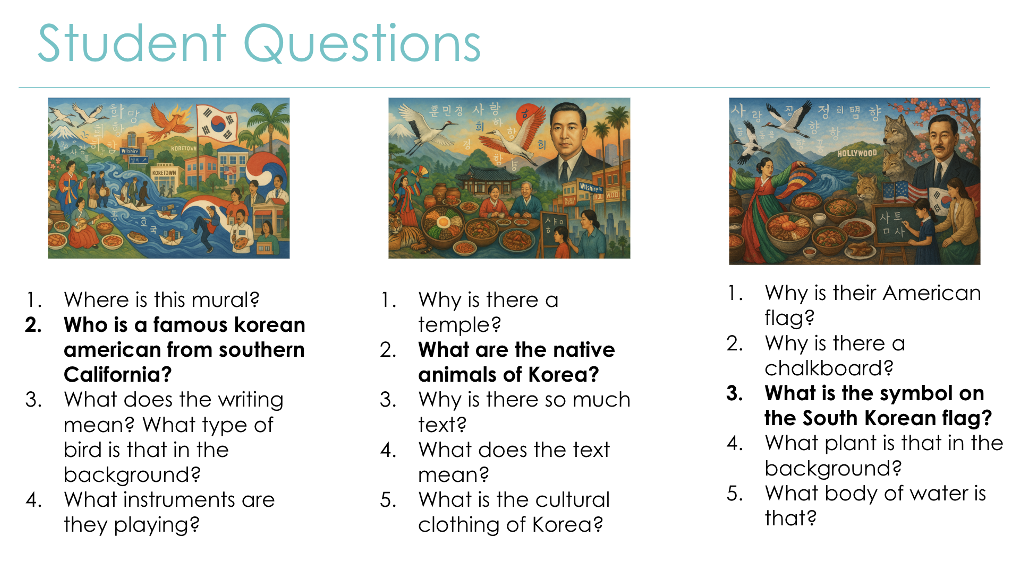
RESEARCHING QUESTIONS TO CREATE BETTER PROMPTS
After generating and prioritizing questions about each AI-generated image, students researched their priority question using google AI and checking its sources. The research informed the prompt they fed to AI for the next round. After 5 rounds, they reflected on how well the image represented what they now understood about their country/culture of choice.
STUDENT REFLECTION EXAMPLE: CHALLENGES OF GUIDING AI
“...AI also gave incorrect information. It created things I did not instruct it to, and it would make big changes even when I asked for small ones. When asking some questions, I need to be more specific to get the mural to be up to the standards I want it to.”
-8th Grade History Student Reflection
THE POWER OF PROCESS AND REFLECTION
When students are able to reflect and share their takeaways with each other, they create teachable moments that resonate more deeply with each other than any I could possibly generate through a traditional direct instruction method. I shared my reactions in parentheses happening in my head as students shared their written reflections with each other.
It always manages to make something I’m not expecting.
I don’t like that it’s a whole lot of research.
(I love this one! They don’t like it, but understand that research is important!)
I struggled with finding the right wording to make it easier to understand.
(Yes! Your words and search terms are vital to working with AI!)
It listened to my corrections and was able to apply most of them.
It led me to ask more questions when finding things I was unsure of.
(I LOVE that this student sees questioning as an empowering tool)
It wasn’t always the most accurate, and sometimes would make mistakes and weird images would come out.
It would make general connections, but the smaller ones were hard to communicate and fix.
(Working with AI requires attention to detail!)
I liked that it was less work using AI.
It was fun to see the different picture it made and the glitches.
I liked that when I asked it questions about the image that it made, it gave more information that was helpful.
(Yes. I want students to demand clarity from it.)
Some of the “facts’ aren’t always correct.
(Be skeptical and always fact-check your sources!)
I liked how it got me questioning more and more.
(This is the heart of my teaching philosophy: To question is the answer.)
Ultimately, using AI in the classroom provided an excellent opportunity to engage in a process-based project where students’ reflections on the process, not the product, was the objective. After sharing their reflections as a community, our students were able to develop a sophisticated understanding of the technology and how to wield it, as well as appreciation of the diversity of the Asian continent, cultures and immigration journeys to our state. And, giving students an opportunity to get feedback from family members, and share their findings with the greater school community, made this a surprisingly impactful and humanity-affirming experience.
To learn more about teacher’s takeaways, read part two (coming soon!).
Johnny Walker teaches 8th Grade World History at Campbell Hall Episcopal School in Studio City, California. Prior to that, he taught high school history for ten years at Triumph Charter High School in Los Angeles. Johnny also works with The Right Question Institute, teaching educators to bring the Question Formulation Technique into their practice and develop classroom communities of inquiry, curiosity, and critical thinking. Johnny holds a B.A. in History and Political Science from Yale University and an M.A. in Teaching Secondary Social Science from The University of Southern California.